The tool The board, the guide and the plan
Decision-support / Simulation tool

Watch a score climb, move by move

Load an organisation and the board scores its structural health, maps who decides locally against who escalates and lists every move open to you.
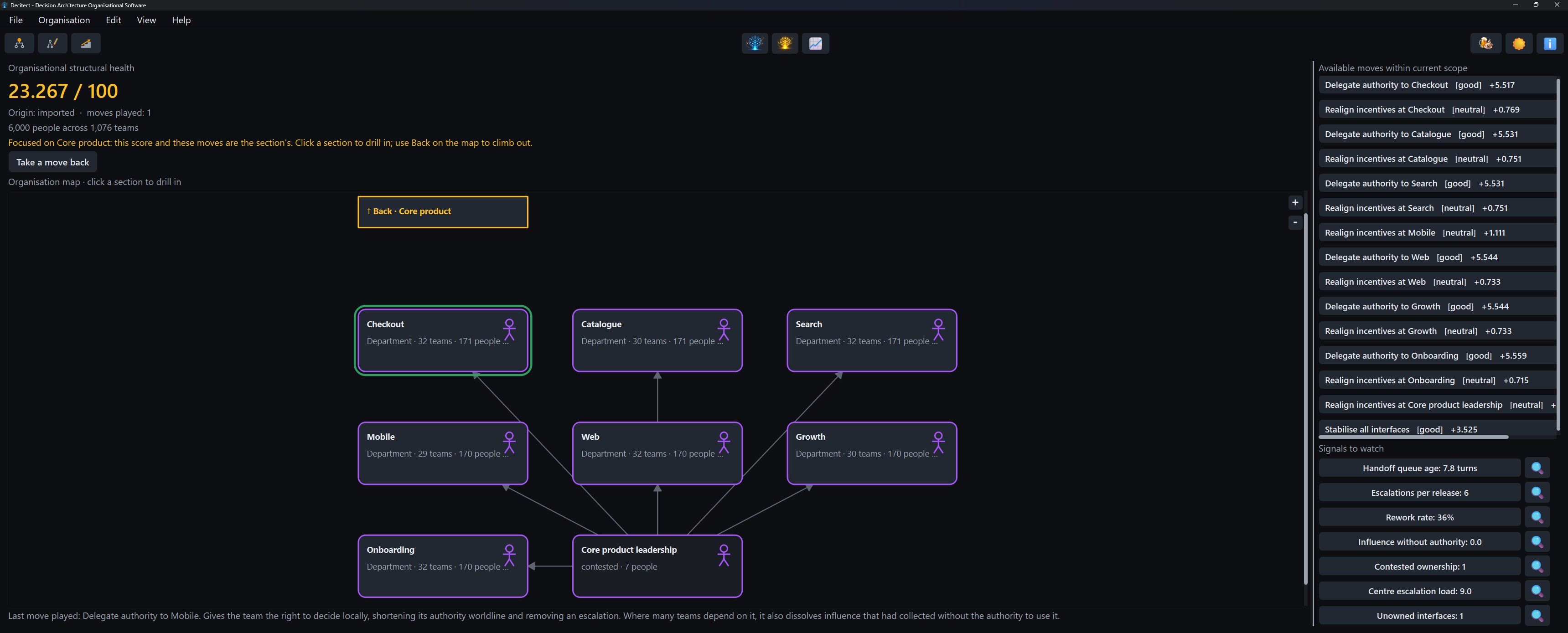
The Decitect board drilled into the Core product section of the six-thousand-person enterprise, with the section's score, moves and signals; the header tray carries the donate button beside the light and dark toggle
The position. The shipped matrixed enterprise, 6,000 people across 1,076 teams, drilled into its Core product section after one delegation: the 23.267 score and the listed moves belong to this section, not the summit. Each department stands as one node here beside the section's own leadership, whose lead is contested and drawn violet. The board is precise about what this frame wants: delegating authority to any one department rates good at around +5.5, stabilising its interfaces rates good at +3.525 and realigning a department's incentives sits neutral at under +1.2. The seven signals flag the 7.8-turn queue age, the 36% rework and a centre escalation load of 9.0; a click on any department drills into it and the corner chips zoom the map at any depth. In the header, the donate mark sits just left of the light and dark toggle.
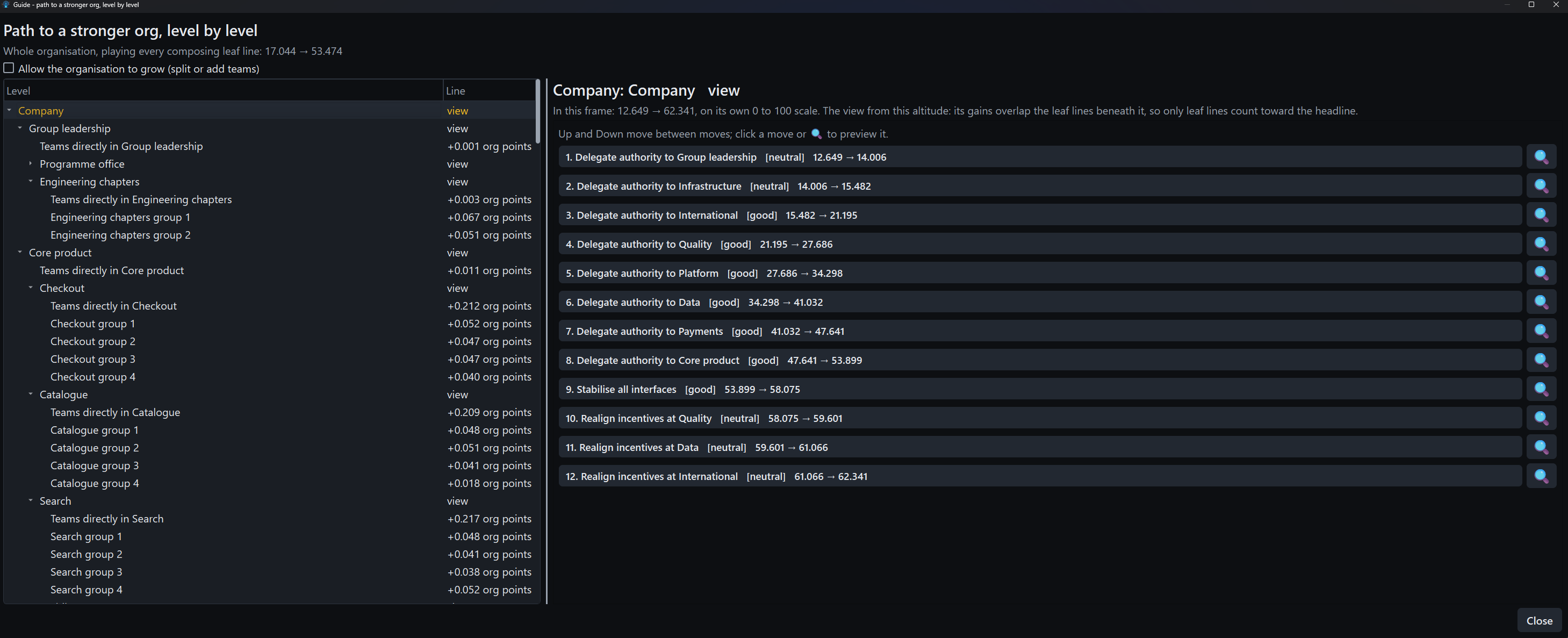
The Decitect guide: the level tree beside the company frame's own line, every step priced from its before score to its after score
The line. The guide plans every level of the enterprise at once: the left pane lists each frame's line with its worth in org points and the composing leaf lines climb the whole organisation from 17.044 to 53.474. Teams sitting directly inside a unit that also holds sub-units get a row of their own (Teams directly in Checkout, worth +0.212 org points), so no team is lost between tiers. The right pane plays the selected frame move by move, here the company frame itself climbing 12.649 to 62.341 on its own 0 to 100 scale over twelve moves: eight delegations, a stabilise, then three realigns. It is labelled as the view from that altitude: its gains overlap the leaf repairs beneath it, so only leaf rows count toward the headline.
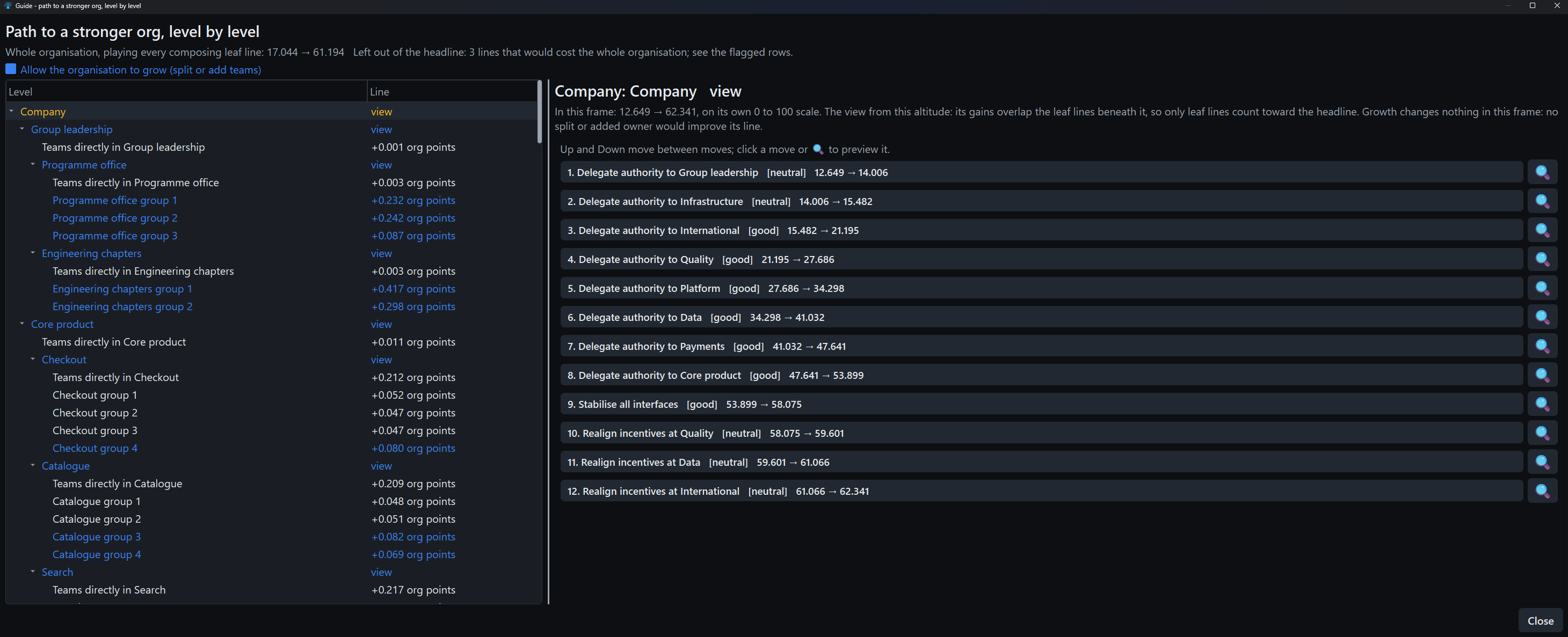
The Decitect guide with growth allowed: the whole organisation climbing 17.044 to 61.194, the rows growth changed picked out in the tree and the company frame noting that growth changes nothing there
Letting it grow. Tick Allow the organisation to grow and the guide replans with splits and added owners on the table: the whole organisation now climbs from 17.044 to 61.194. Three lines that would cost the whole organisation are kept out of that headline and flagged, so the climb the tree advertises is one the organisation would actually make. The rows whose line growth changed are picked out in the tree (the engineering chapters' first group rises from +0.067 to +0.417 org points); the rest keep the line they had. A frame that growth cannot improve says so: the company frame's own line is unchanged and reads that no split or added owner would improve it.
The output

From a played line to a plan you can send

One click exports the moves you played as a self-contained HTML report: the health change, before and after maps and a recommendation section addressed to each unit's lead, each move justified by the signal it eased. It lands in your Downloads folder under a name that never overwrites an earlier one and opens straight away for reading. Every move is judged twice: against the whole organisation and (where it acted inside one unit) within that unit's own frame, so a repair that is good where it lives never vanishes into whole-org neutrality. This is a real export, embedded here as shipped.

The report. Eight moves on the matrixed enterprise, priced honestly at both scales: structural health climbs from 16.255 to 21.264 and every move names its lead, its org-wide verdict, its frame verdict and the signal it moved. This is the whole argument in one page. Every one of the five organisation-wide delegations reads neutral against the summit while reading great inside the section it acted on, the Data delegation taking that section from 16.917 to 54.528 for a whole-org gain of under two points. Two moves run the other way and read bad within their own frame while still neutral org-wide. Each rationale names the signal that actually moved, escalations per release falling 891 to 674 across the eight. Recommendations are grouped by the lead who holds them, CTO-level moves separated from a domain's own. The record separates earlier runs' moves from the current run's by colour and a JSON twin exports alongside it, so the organisation and its played moves re-import to resume.